
by Alex Carrigan
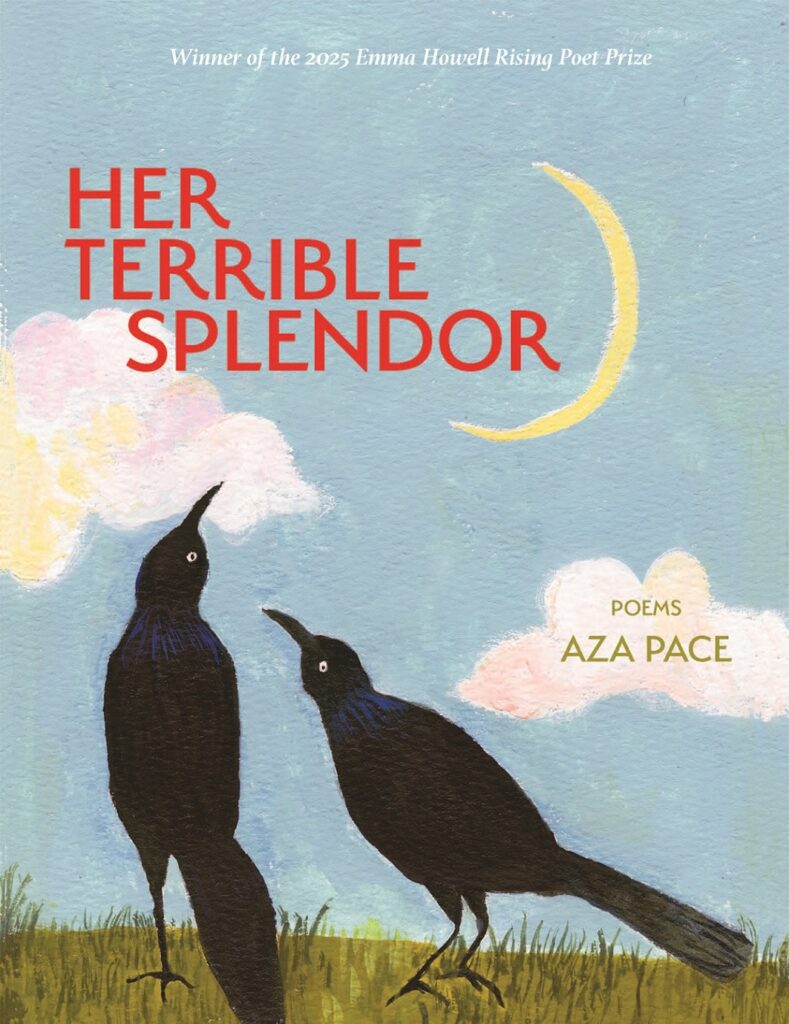
Aza Pace’s Her Terrible Splendor (Willow Springs Books) is a newly-released collection of poems that discuss femininity, romance, nature, magic, and rituals through the lens of the mythological witch Circe. Circe, who in The Odyssey would turn men into pigs and proved to be one of many challenges for Odysseus, takes on a knowable and unknowable form in this collection. Pace’s poetry is at conversation with and speculates about the witch, tying how her isolation and control over men can relate to the poet’s experiences coming of age in East Texas.
The collection is divided into four sections – Apparitions, Transformations, Pleasures, and Becomings. Each section plays with an aspect of Circe, deconstructing or reimagining these parts of her in a modern lens.
The first section, Apparitions, dives deep into the witch imagery, with many of the pieces being about rituals and spells, while also looking at what a witch is. This section also introduces the first of Pace’s ekphrastic and after poems, with some based on artistic interpretations of Circe in art and dance.
The next section, Transformations, moves the imagery of the collection from the forest to the sea, while still containing a multitude of ekphrastic poetry, namely after the works of John William Waterhouse. It’s also here that Pace begins to introduce duos and couples into the poems, going beyond Circe and Odysseus and introducing pairs of women. Poems like “Story” and “Portrait at the Storm Edge” introduce a pair of young women and how they hold rituals a la witches. “One cuts off her hair / one slicks on liquid liner / to get her cat eyes just right…” she writes in the latter.
Pleasures, the next section, features more poems of the narrator and Circe in modern spaces. Here, Pace seeks to converse and understand the witch further by taking photos of her in “Snapshots with Circe,” discussing lesser-known aspects of the character, such as her child with Odysseus in “Circe and Child.” Here, Pace writes,
Be careful with your
subtle flesh, dove, careful
with your strength.Be careful with the tools
I give you, and the wide world
where I unleash you.
Following this, and into the final section, Becomings, Pace begins to move away from Circe and into the more personal. Circe may have been a temptress and a danger, but she was ultimately a lonely figure unable to connect to anyone. The poems in this final section look at isolation and what to do with the strength one possesses. These pieces ruminate on nature and the longing to connect with more of the world beyond the natural space around oneself. “Solitude has its thrill, / part mystery, part ticking silence” Pace writes in “The Breathing Room.”
Her Terrible Splendor is a reimagining and a reexamination of a witch who had all the power and knowledge at her disposal, but lacked the ability to go beyond her island and connect with the world. By placing the character in modern contexts, Pace seeks to highlight the growing isolation in the modern world, where all the avenues to connect and bond can’t help if someone isn’t willing to budge. These poems are gentle and open, offering all sorts of avenues through the seas to find somewhere to resonate.
Alex Carrigan (he/him) is a Pushcart-nominated editor, poet, and critic from Alexandria, VA. He is the author of Now Let’s Get Brunch (Querencia Press, 2023) and May All Our Pain Be Champagne (Alien Buddha Press, 2022). He has appeared in SoFloPoJo, Cotton Xenomorph, Bullshit Lit, HAD, fifth wheel press, and more. Visit carriganak.wordpress.com for more info.


Add your first comment to this post