by LE Francis
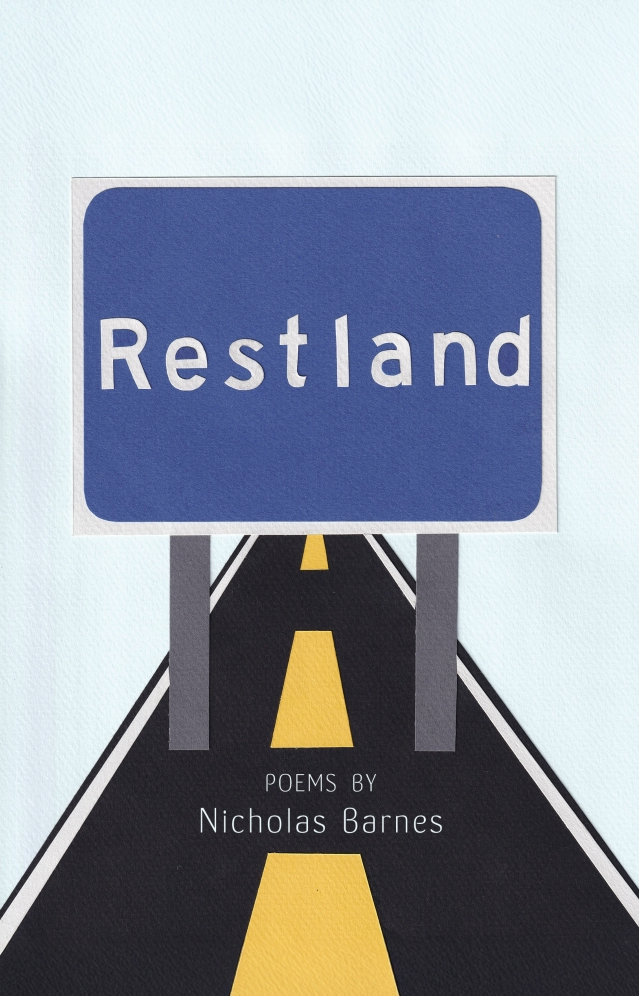
Nicholas Barnes’ debut chapbook “Restland” is a sweeping collection of vivid imagery, emotion, & revelation. The collection was released June 7 from Finishing Line Press. Barnes’ work has been previously published here at Sage Cigarettes Magazine.
For readers, “Restland” offers a familiar glance at a shared past — edges of experience line up, hit & glance. The reason we “attempt to lock pain away in poems” as Barnes intimates in the opening poem — “a child said, what is the grass?” — is not a simple self-preservation instinct but a prevailing human effort to couch the unyielding heaviness of existence into art so it can be opened & rediscovered & reconstituted by any eye, any mind, open to the experience.
& the carefully plotted lines of these poems ring in all the senses, call up universal memory, bringing to life familiar worlds of schoolyard & childhood recollection.
“swing set scene, sawdust mulch,
pea gravel, metal clip ringing
against the flagpole.”
— “yolanda”
There is something so tactile, so real, about the lines that act with almost mechanical precision drilling into the memory of the reader to retrieve all the parallel moments from their lives, conjuring a thousand paper milk cartons with gills of separated spouts.
In poems like “painting hands,” “june watches ballgames in heaven,” & “eighth grade funeral” there is an unflinching gaze at death from innocent eyes that stitches through, adding context to the rest of the collection.
“where do cowboys go when they die? boot hill. until god comes along, paints their portrait, and puts them up in heaven’s waiting room.”
— “painting hands”
& these searing lines act as a counterbalance, an explanation to how there is still hope despite the usual devastations of childhood. There is a magic, a restoration to the passage of time that death punctuates.
“for the past fifteen years,
i’ve been calling collect.
i never really got through.
but on those rare nights,
i saw you, smiling.
you knew my name again.”
— “june watches ballgames in heaven”
& yet between the magic & the tragedy there is the unwavering mundanity of human existence — our unavoidable frailty of life that once seen squarely, sends cracks through any remaining precipice of innocence.
“little wooden ticonderoga pencils
primed to snap, splinter,
and choke under pressure.”
— “eighth grade funeral”
& that grudging capitulation of innocence winds through the collection. You can feel the narrator’s fingers being pulled one by one, unwillingly from the lighter lines. A bitter undercurrent sweeping in to reveal how life has inconceivably changed the landscape of mind & spirit.
As the dust settles, what remains is a sense of fragmentation caused by the scattershot light of experience falling against the narrator’s internal landscape. Pieces of self are tucked away, mythologized, explained into another form — making deals with a monster in “armistice,” the elegant satin-clad woman in “fairy tale.”
“i was scared of what they’d call us, so i squashed her with my boot heels.”
— “a sudden shift in glasnost”
There are hard truths reached, painful memories revealed, only to turn & pine after the simplicity of memory, the scenic past where all the little fragments of self were painted into the landscape, making an otherwise rough world beautiful.
& still there is hope that what has been transformed once can be transformed again & in that hope is a great act of rebellion. Despite a world that has done everything possible to harden our hearts, softness remains living & breathing in our words & the inner worlds that have been conquered but not abandoned.
The procession of poems winds through hope & loss & revelation, coming finally to a place of synthesis in the last few selections. I don’t think I have ever personally resonated more with a line than:
“i get what i always wanted: to live life in a vacuum. no one will know me. just like that first coat of paint on aunt polly’s white picket fence.”
— “now i know why tom & huck staged their own funerals”
But then again, that is the function of the poetic narrator. It is not the author but the voice the author cultivates — it is invisible, true, able to see & synthesize beyond the day-to-day voice of the human author.
& our narrator’s gratitude for living a live with & through art, comes in with a punch in the final poem, “au revoir.”
“i’ll laugh
with my last
rattling breath,
knowing i got out
while there was still
water to drink”
— “au revoir”
“Restland” is a chapbook to empathize & commiserate with, to feel gratitude with & for. Though our monsters, our pasts, & our ideal selves may vary, this collection is a raw & vividly human look at the difficult process of growing up differently & the beauty of being able to capture the pieces of it in vision, in art.
You can purchase “Restland” from Finishing Line Press. He also published “until next time, buddy” here at Sage Cigarettes on Nov. 14, 2022.
LE Francis (she/her) is a recovering arts writer living in the rainshadow of the Washington Cascades. She is the co-EIC of Sage Cigarettes Magazine. She is a Pushcart-nominated poet & her debut chapbook THIS SPELL OF SONG & STAR is available through Bottlecap Press. She plays bass in the indie/prog band Hands Above Stars. Find her online at nocturnical.com.

Add your first comment to this post