by Lauren Kardos
Before the end, he told me he burned all his photographs, but the albums I pull from the trunk in my grandfather’s attic have soft edges. Each photo oft-handled, plastic peeled away from each album’s pages.
And this photograph, I’ve seen a copy before. The Great St. Patrick’s Day Flood, 1936 says the exhibit label in our town’s historical society. The old diner windows peek from the currents. Rocking chairs float near the inn’s wraparound porch. Seems half the town crowds around the flood line. Hands shoved in peacoat pockets, hats pulled over ears, neighbors peer toward third street where the photographer stood. All look uphill, except one little boy, seven or eight, upper body swiveled backwards. He points toward the river. That there’s Pappy, my father pointed to the boy during our one historical society visit years ago. We had ridden our bikes through town, my training wheels recently removed.
I don’t know if that boy was truly my grandfather. Could such a man, gnarl-fingered and stooped from decades of steelwork, have once been a child? A sliver of his right cheekbone is visible in black and white, a photo I’ve not seen in two decades at least, but I tell myself, I know that cheekbone. The hook for the curtain of his grin when he stole my nose and pulled quarters from my ear. I hated when he jumped from behind door frames, hollering Boo! Perhaps 1936 was the year he still only spoke Slovakian. Perhaps all he could do was point at the water, words he didn’t yet have for that cold leviathan that might’ve swallowed him whole.
Seems Pappy stopped sweeping ash from his fireplace at some point. I hope the stench is just critters dead in the chimney. I chisel soot with the poker, sweep ancient crust into the tarnished dustpan to keep from wondering why he didn’t ask me to come by more. Over my shoulder, a crack, a creak. Go look, you baby, I tell myself, so I do. A step before the dining room, I pause, swallow my runaway heartbeat, expecting to see his sausage-thick fingers, labor-hardened nails, wrapping around the doorframe. Boo! Back at the hearth, I pull from the yellowing newspaper stack. Ball pages into tinder, just like he taught me. My ink-stained palms, I wipe onto Pappy’s limp flannel slung over his recliner.
Another photo found while cleaning out the trunk. Sepia-toned color. My grandfather sits in a wingback chair beside the fireplace, my toddler-aged father atop his knee. 1963, William, says the cursive on the back. Though my father reaches toward the camera, Pappy only has eyes for the fireplace, a roaring blaze bleached white with exposure. Left cheekbone shiny like the poker set polished and new in the picture, the brick scrubbed clean. Did you know, my father always started when I displeased him, that when your uncle and I misbehaved, Pappy had us go out back and find a switch? One winter evening, we let all the heat out the back door, and Pappy made us sleep in the attic. Just a single blanket for the two of us.
I never knew that side of my grandfather, the one that kept my father yessir-ing and no-sir-ing ‘til his deathbed. A giant, malevolent. My Pappy played Pretty, Pretty Princess with his granddaughter. My Pappy gave lollypops after his pranks drew tears. Gotta keep yinz kids on your toes. A man I loved, but one I was told to always keep an eye on, to treat like a once-feral dog. When I ask for my father’s help clearing out his childhood home, he says: Take what you want. I’d burn it down if I could.
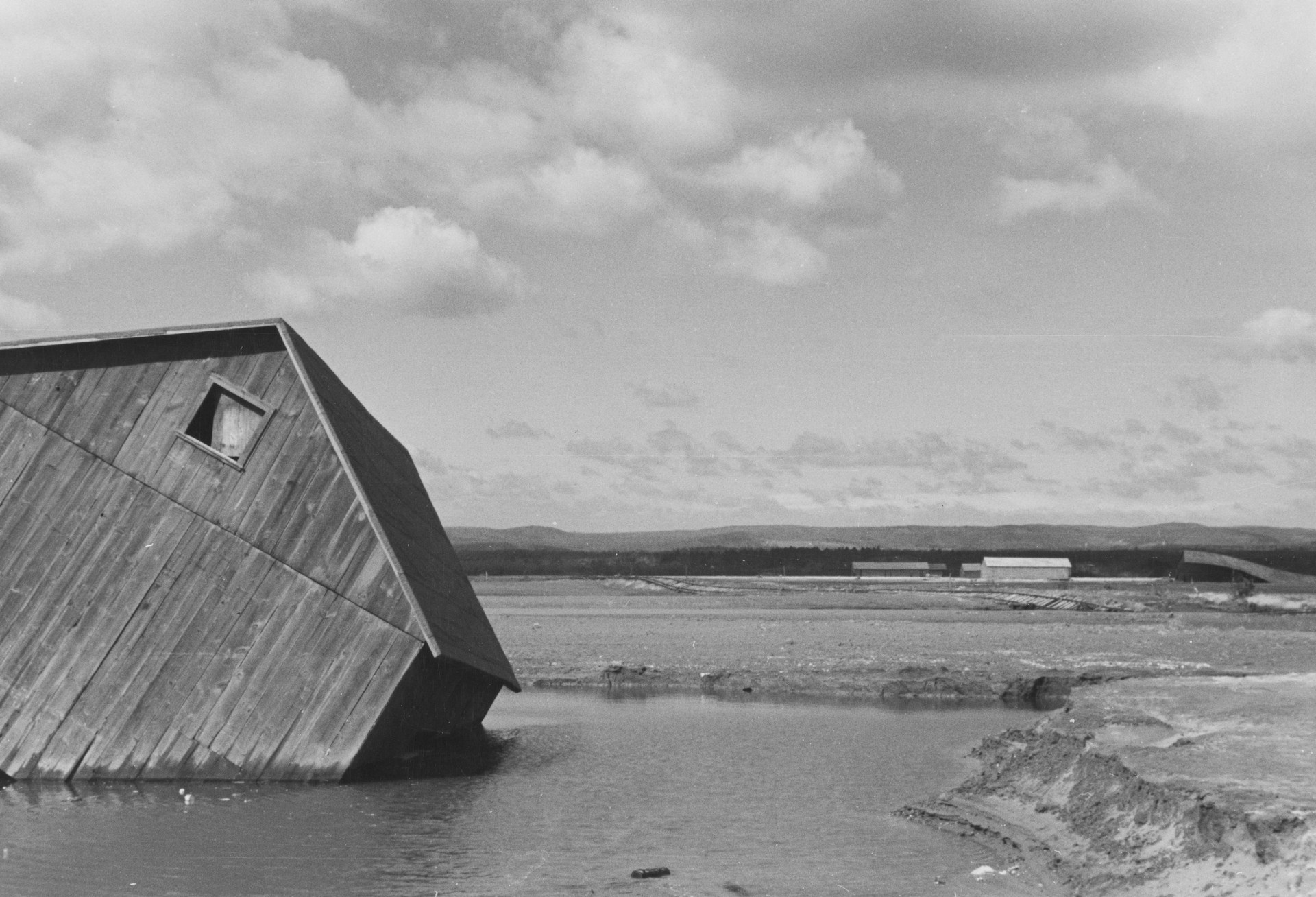
I never asked Pappy what the Great Flood was like, but I think I can guess, kneeling by the blackened hearth. Perhaps it took weeks to shovel Allegheny silt from the grocers’, to unearth the train tracks into town. Months to cart away debris. Years to rebuild a semblance of what was lost. Another historical society photo I still remember. A modest Sears kit-house upside-down, wooden beam foundations belly-up. Roof stripped shingle-by-shingle in the current. Was that the neighborhood Pappy’s family first lived, down by the riverbank? Perhaps the cold and damp never left Pappy’s bones. If I could ask him now, would he answer honestly or spin a tale like all those evenings he babysat and we huddled close to the fire? My fingers singe, and I yank them back from the popping cherrywood logs, now aflame. Did I set that? I ask into Pappy’s old den, search my inkblood fingertips. A crackle behind me, then a hiss from the dining room. Boo! Reaching for more newspaper, I tell myself, perhaps it was nothing.
Lauren Kardos writes from Washington, DC, but she’s still breaking up with her hometown in Western Pennsylvania. Milk Candy Review, Flash Fiction Online, Lost Balloon, and Best Microfiction 2022 are just a few of the fine publications that feature her words. You can find more of her work at laurenkardos.co.


Add your first comment to this post