by Amanda Wittman
I saw a meme that called for a “Pedro Pascal and Public Library Summer.” I was immediately sold. It may be less catchy than “Barbenheimer” or more of a mouthful than “Brat Summer” but it aligns with my Pedro obsessed, nerdy, literacy girl vibe. Plus, I needed something to focus on as a positive distraction from… gestures around broadly indicating the hellscape that is the current American experience.
Leaning into Pedro Pascal summer was easy. Seeing The Materialists, Eddington and The Fantastic Four: check, check and check. Following his summer press tours and having opinions on how much he and Vanessa Kirby can’t keep their hands off each other (you do you, boos). The Vanity Fair photo with Pedro’s booty prominently featured in the mirror. I was here for all of it!
In terms of the public library portion, I am extremely fortunate to be an Erie County resident and therefore belong to the Buffalo and Erie County Public Library. This system consists of 37 branches and a book mobile that stretches over approximately 1,220 square miles covering the city of Buffalo, NY and surrounding towns.
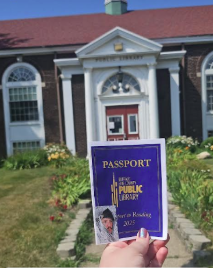
The library system runs a “Passport to Reading” program in summer. Participants get a little paper booklet which breaks down all the branches by geography: City, North, South and East. There are around 8-10 circles on each page and when you visit the corresponding library, you are awarded with a circular sticker. At the end of the summer, you submit how many libraries you visited for a chance to win prizes. But as the saying goes(ish)…the real prize is the friends we made along the way.
My husband, Steve, and I are not necessarily competitive, but if you give us a list, we will knock that shit out. Our goal quickly went from “visiting libraries when we are in the area and see how many we can get” to “visit all branches this summer”. Steve is a whiz with directions, so he cross-referenced operating hours with locations and mapped out routes for us to hit several branches in a single day. I, on the other hand, had the ever so important task of finding a local coffee shop near our starting point, so we could fuel ourselves with caffeine and sugar to start the day’s adventures.
When going up to the checkout counter to get our passport stamps, the librarians were excited to greet new visitors. They would ask where your home library is, how many locations have you visited so far, or which branch is your favorite. When posed with that last question, my answer is always a resounding “Boston!”
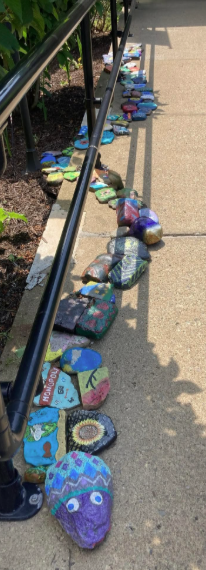
Boston, NY is a small rural town of approximately 8,000 residents located to the south of Buffalo metro. This summer was my first visit to the Boston Free Library. My first impression was that the building was rather unassuming. I guess this could be a lesson in not judging a book by its cover (please insert groan here). It was a small but well-maintained, brick building. Making our way to the door, we were greeted by Ripley, the rock snake, a community art project. This was one large rock painted like the head of a snake, followed by several smaller painted rocks that weaved their way up the pathway welcoming visitors in. This should have been the first clue that my little nerd heart was in for a treat.
Inside the library, we were greeted by not only the sweetest librarians in all of Erie County (remember, I’ve been to all branches, so I speak as an authority here), but also their therapy dog, Budgie. The staff were welcoming, giving us bottled water since it was a hot day. They were excited that we came to visit their library and loved the idea of documenting our visits on social media. I was even able to include Budgie in my passport photo.
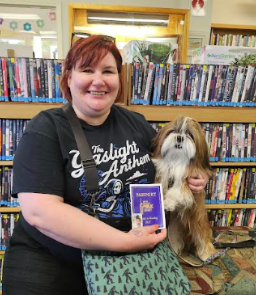
As we chatted about the building with the librarians, we were told a wide range of stories from programs they offer, paranormal encounters, and delightful memories of a former era.
Before it was a library, the building originally served as a school. The librarian explained how a few years ago they hosted a reunion and former students came to visit. One of the alums shared a story from 1953. At that time, a resident of Boston was one of the lucky few in town that owned a television set. On June 2nd of that year, the students all walked to this person’s home and watched Princess Elizabeth’s Coronation on their TV set.
I fell in love with this little piece of history, because it is a slice of what life looked like for those students at that moment. It may not be something that was newsworthy, but it was a lasting memory those kids carried for the rest of their lives. I just imagine a community gathered in a living room to watch grainy footage from across the Atlantic on a 14-inch screen. In contrast, it sort of makes watching clips on your phone feel a little lonely.
If it’s not already apparent, in addition to being a literacy nerd, I also really dig history which is why the Lackawanna Public Library was another exciting location to visit. Despite growing up only a few towns over from the City of Lackawanna, this was once again my first visit to their library. I didn’t know what I was expecting, but it certainly wasn’t a gorgeous brick building, with tall arching windows that greeted us on arrival. I was already in awe of the building, but when I passed the sign which read “A Carnegie Library” I completely geeked out.
For some historical context, about 100 years ago the world’s richest people actually gave back to society rather than hoarding wealth. One such philanthropist was Andrew Carnegie, who gave 90% of his wealth back through a variety of charitable means, including building libraries. The legacy and his motivation for donating can be a little convoluted, but the fact remains that because of Carnegie, over 2,500 libraries were constructed in the late 19th and early 20th century.
Entering this exquisite building is to be captivated by the gorgeous woodwork, spacious layout and two working fireplaces. The East and West rooms featured black and white photos of what the rooms looked like in the1930’s. This is evidence of how beautiful features were preserved but with the addition of computers and expanded book sections, progress has also been made.
On a whim, we decided to check out the basement of the library before we left. A large meeting space was decorated with vintage toys. While making our way around the room, we exited a pair of French doors leading to another hallway. We were not aware that the basement was this large and kept moving down the hall until we discovered a history museum.
The collection displayed local artifacts celebrating Lackawanna’s history. There was a man inside the room (whom we later joked may have been a ghost) that pointed out his favorite items in the collection from an old school music box to a display dedicated to the Vietnam War. My favorite items were wedding dresses from the early decades of the 20th century. One of the dresses even belonged to Clara Whealen, a local resident who was instrumental in lobbying Carnegie for funding to build the library.
Driving away, we reflected on how grateful we were to have gone to the basement. We had no idea about this hidden gem located down there and loved roving amongst the artifacts of a bygone era. Of course, we learned the importance of basement snooping from the Leroy R. Coles, Jr. Library located within the city of Buffalo.
While at the Coles branch, collecting our passport stamps, we were talking with an impossibly cool staff member. She was wearing a “Black Death European Tour 1347- 1351” T-shirt and had a shaggy mullet-esque haircut that I could never pull off. I immediately wanted to be her best friend.
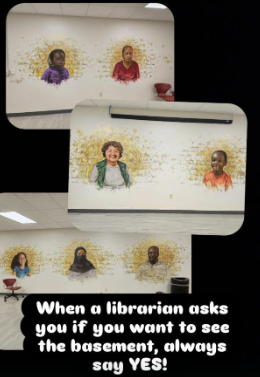
As she gave us the run down about the library she asked, “Have you ever been in the basement?” Interest piqued, we made the subterranean descent to discover gorgeous murals from local artist, Julia Bottoms. The murals are realistic paintings of library patrons which showcase the diversity of the branch community. The murals invoke adoration as you gaze upon them and marvel at the talent of the artist to capture the beauty and joy of her subjects. This turns an otherwise generic meeting space into a welcoming, bright environment and serves as a reminder that libraries are for everyone.
Libraries go beyond books and learning; they are also a place for the community. Whenever I visit a library, I always take a moment to peek at the bulletin board which displays upcoming programs and events. This programming serves the entire population from children’s story time to classes to help people navigate Medicaid and Social Security. There is programming for all interests, from LEGO clubs to crafting activities and silent book clubs, where folks just gather to read, all for free.
Libraries are a safe space for all members of the community. Their lending materials extend beyond media, proving the importance of adapting to an ever-changing world. Several branches that we visited converted old card catalogues into seed libraires for patrons who are looking to garden. I was also introduced to “The Library of Things” which are goods available for checkout. These ranged from practical items like sewing machines, to fun stuff like movie projectors and inflatable screens for outdoor movie nights, yard games and fishing poles. Having these types of materials to borrow can help alleviate cost barriers from trying new skills and hobbies or having fun experiences.
Let’s circle this back to Pedro Pascal. He isn’t just a talented dream boat actor; he is also an advocate. He has been vocal on the importance of trans rights for years and has spoken on behalf of the immigrant experience. Embracing this spirit of advocacy has become another part of Pedro Pascal and Public Libraries Summer. While I obviously do not have anywhere near his reach or influence, I still believe that using your voice matters.
Public institutions like libraries are under attack. If not the threat of cutting funding or the call to ban books, libraries are caught in the crosshairs of a society seemingly intent on moving backwards. While doing research for this article, I learned that Carnegie libraries held symbolic structural designs. Walking up to a Carnegie library, a light post should be placed near the door as a symbol of enlightenment. When entering the building, patrons are met with a set of stairs, indicating the learning and education was an upward path. While over 100 years old, (and accessibility issues withstanding) these sentiments should continue to be amplified, rather than trampled.
If you are a regular library patron, I suggest you branch out and explore more libraries. Visiting different locations allows you to discover new places and learn more about the history and culture of the area. If you haven’t been to a public library recently, what are you waiting for?! There is so much available to you! Libraries need help and support more than ever. Go get your library card and see what wonders await you. I’m pretty sure it’s what Pedro would want you to do.
Amanda is from Buffalo, NY (Go Bills!) where she lives with her husband, cats and corgis. Amanda’s work has been published in vols. XI and XII of The Feminine Macabre and the Halloween Anthology Twisted Tales to Tell in the Night.


I love this! Great job ❤️
I’m going to check out the Lackawanna library! It’s right near Carls house 😊